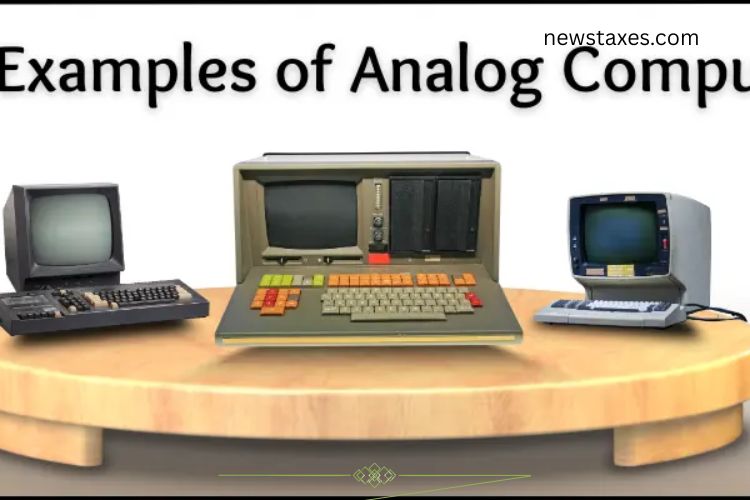
Analog computers played a crucial role in human innovation long before modern digital systems existed. These machines solved problems by using physical quantities such as motion, pressure, temperature, and electrical signals instead of binary numbers. Engineers, scientists, astronomers, economists, and military experts relied on analog computers to perform real-time calculations and simulations that were impossible by hand.
Below are 20 important examples of analog computers, each showing how early technology transformed problem-solving across different fields.
Read More: Essential Types of Microcomputers You Need to Know
Slide Rule
Slide rules helped users perform multiplication, division, logarithms, and trigonometric calculations quickly. Engineers and students widely used them before electronic calculators became common. Their simplicity and portability made them an essential everyday tool.
Key Strengths:
No electricity required, portable, fast for basic math
Limitations:
Limited accuracy and unsuitable for complex calculations
Planimeter
A planimeter measures the area of irregular shapes, especially on maps and drawings. Surveyors and engineers used it to calculate land size accurately by tracing boundaries.
Key Strengths:
Accurate for curved areas, easy to use, portable
Limitations:
Less effective for very complex or tiny shapes
Nomogram
Nomograms use charts and scales to solve mathematical formulas visually. Engineers, doctors, and scientists relied on them for quick calculations without needing electronic devices.
Key Strengths:
Fast results, simple design, no power required
Limitations:
Limited problem range and reduced accuracy
Antikythera Mechanism
The Antikythera Mechanism is one of the earliest known analog computers. Built over 2,000 years ago, it predicted astronomical events such as eclipses and planetary movements using intricate gears.
Key Strengths:
Advanced astronomical modeling for its time
Limitations:
Fragile, complex, and limited in scope
Differential Analyzer
This large mechanical computer solved differential equations used in physics and engineering. Scientists used it to model motion, energy, and mechanical systems.
Key Strengths:
Handles complex equations efficiently
Limitations:
Large size, delicate setup, and limited portability
Water Integrator
Water integrators used flowing water to model and calculate hydraulic systems. Engineers applied them to study rivers, dams, and large water networks.
Key Strengths:
Accurate for fluid flow, real-time results
Limitations:
Bulky and restricted to water-based calculations
Reeves Electronic Analog Computer (REAC)
REAC marked a shift from mechanical to electronic analog computing. It used electrical circuits to solve engineering and military problems rapidly.
Key Strengths:
Fast processing and reduced human error
Limitations:
High power consumption and limited flexibility
AKAT-1
AKAT-1 was a mid-20th-century analog computer designed for scientific and engineering calculations. It contributed to early computational research.
Key Strengths:
Efficient for complex math
Limitations:
Large size and maintenance demands
THE ANALOG THING (THAT)
THE ANALOG THING simulates physical systems using real-world signals. It supports real-time experimentation and system modeling.
Key Strengths:
Quick problem solving and compact design
Limitations:
Limited precision and storage capability
Astrolabe
Astrolabes helped sailors and astronomers measure celestial positions. They played a major role in navigation and timekeeping for centuries.
Key Strengths:
Portable and versatile
Limitations:
Requires skill and clear skies
Torquetum
The torquetum allowed astronomers to convert celestial coordinates. It improved star tracking and planetary observation.
Key Strengths:
Accurate for basic astronomy
Limitations:
Manual operation and limited calculations
Kerrison Predictor
Used during World War II, the Kerrison Predictor helped anti-aircraft units calculate enemy aircraft movement for accurate targeting.
Key Strengths:
Improved targeting speed
Limitations:
Heavy and weather-dependent
Norden Bombsight
The Norden Bombsight calculated bombing trajectories using aircraft speed, altitude, and wind conditions.
Key Strengths:
Enhanced bombing accuracy
Limitations:
Weather sensitivity and mechanical complexity
Castle Clock
Built in 1206 by Al-Jazari, the Castle Clock combined water flow, gears, and automation to track time. It stands as a masterpiece of early analog engineering.
Key Strengths:
Innovative design and visual appeal
Limitations:
Large size and limited functions
Tide Predicting Machine
This machine forecasted ocean tides using mechanical components. Mariners relied on it for safe navigation.
Key Strengths:
Reliable and electricity-free
Limitations:
Large and slow to operate
Mechanical Calculator
Mechanical calculators used gears and levers to perform arithmetic operations, making office and scientific work faster.
Key Strengths:
Durable and easy for basic math
Limitations:
Limited functions and manual effort
Analog Oscilloscope
Analog oscilloscopes display electrical signals as waveforms, helping engineers analyze circuits and signals in real time.
Key Strengths:
Clear real-time signal display
Limitations:
Limited frequency range
Analog Sound Processor
These processors modify sound using electrical signals. Musicians and audio engineers use them for real-time sound enhancement.
Key Strengths:
Natural sound processing
Limitations:
Higher power use and maintenance
Librascope
Librascopes supported aerospace calculations for aircraft and rocket systems, allowing engineers to make quick decisions.
Key Strengths:
High accuracy and fast results
Limitations:
Costly and requires expertise
MONIAC
MONIAC simulated national economies using water flow to represent money movement. Economists used it to visualize financial systems.
Key Strengths:
Clear economic visualization
Limitations:
Limited scalability and speed
Frequently Asked Questions:
What are analog computers?
Analog computers are machines that solve problems using continuous physical values such as speed, temperature, pressure, voltage, or motion instead of digital numbers. They provide real-time results and were widely used before digital computers became common.
How do analog computers work?
Analog computers work by modeling real-world systems. They use mechanical parts, electrical signals, or fluid flow to represent variables and perform calculations based on physical behavior rather than coded instructions.
Why were analog computers important in the past?
Analog computers played a key role in science, engineering, navigation, and military operations. They allowed experts to solve complex problems quickly when digital computers did not yet exist or were too slow.
What are some famous examples of analog computers?
Well-known analog computers include the Slide Rule, Antikythera Mechanism, Differential Analyzer, Astrolabe, Tide Predicting Machine, Norden Bombsight, and MONIAC. Each served a specific real-world purpose.
Are analog computers still used today?
Yes, analog computers are still used in specialized applications such as signal processing, audio equipment, control systems, and scientific simulations where real-time performance is critical.
What is the difference between analog and digital computers?
Analog computers use continuous data, while digital computers process discrete binary values. Analog systems are faster for real-time simulations, whereas digital computers offer higher accuracy and storage capacity.
Were analog computers accurate?
Analog computers were accurate within specific limits, especially for real-time modeling. However, they lacked the precision and flexibility of modern digital computers.
Conclusion
Analog computers are remarkable milestones in the history of technology. From ancient devices like the Antikythera Mechanism to mid-20th-century machines such as the REAC and MONIAC, these devices transformed how humans solved complex problems in real time. They bridged the gap between theoretical calculations and practical applications, influencing fields like astronomy, engineering, navigation, economics, and warfare. While digital computers have largely replaced analog systems, the ingenuity behind these powerful real-life machines continues to inspire innovation.