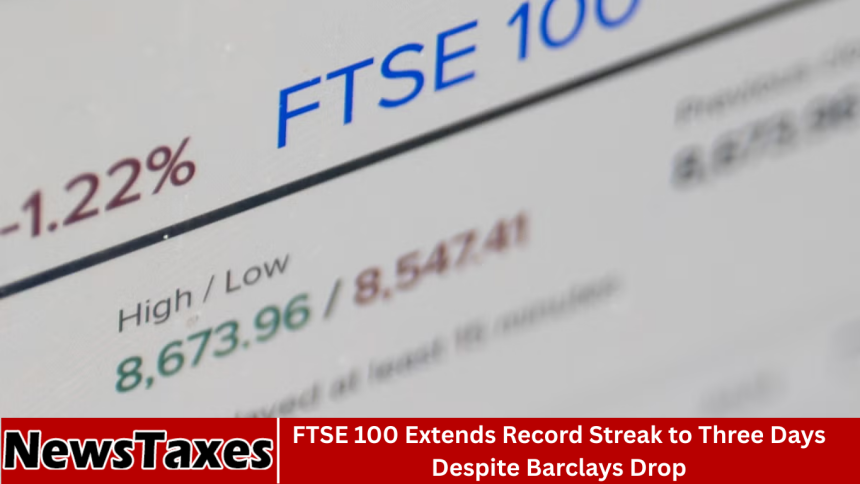
The United Kingdom’s leading stock benchmark, the FTSE 100, continued its historic rally by closing at a record high for the third consecutive trading session. The milestone highlights strong investor confidence in large-cap British companies even as some major financial stocks, including Barclays.
The rally comes at a time when global markets are navigating economic uncertainty, fluctuating interest rates, and geopolitical tensions. Yet the UK market has shown remarkable resilience, with energy firms, mining companies, and consumer giants pushing the index upward.
At the same time, the drop in Barclays shares reminds investors that not every sector is moving in the same direction. Banking stocks, which have benefited from higher interest rates in recent years, are facing renewed pressure from economic concerns and evolving regulatory expectations.
More Read: Brit Awards Glory Caps a Dream Month for Olivia Dean
Understanding the FTSE 100 and Its Importance
The FTSE 100, short for the Financial Times Stock Exchange 100 Index, is widely regarded as the benchmark indicator of the UK’s stock market performance. It tracks the 100 largest publicly traded companies listed on the London Stock Exchange based on market capitalization.
These companies represent diverse industries, including:
- Banking and financial services
- Energy and mining
- Pharmaceuticals
- Consumer goods
- Telecommunications
- Retail
Because the index includes multinational corporations with global revenue streams, its performance often reflects global economic trends rather than purely domestic conditions.
Companies within the FTSE 100 collectively represent a significant share of the UK’s corporate sector. Many of them generate most of their revenue outside the UK, which means currency fluctuations, commodity prices, and international demand can significantly influence the index’s direction.
The FTSE 100’s recent record streak underscores how global dynamics continue to shape the UK stock market.
A Three-Day Record Streak: What Happened?
The index reached new highs for three consecutive trading sessions, driven by strong performances in sectors such as energy, mining, and pharmaceuticals.
Several factors contributed to this surge:
- Commodity price strength
- Weakness in the British pound
- Strong corporate earnings
- Global investor demand for defensive stocks
Large energy firms and mining companies were among the biggest gainers. These companies benefit when global commodity prices rise, as demand for oil, gas, and metals increases.
At the same time, multinational companies in the FTSE 100 tend to benefit when the British pound weakens, because overseas earnings translate into higher revenues when converted back into pounds.
This combination created the perfect environment for the index to climb to new heights.
The Role of Global Markets
While the FTSE 100 represents British companies, its movements are often heavily influenced by global economic trends. The recent rally reflects optimism across several major markets.
Investors have shown renewed appetite for large-cap companies with stable revenue streams, especially those operating internationally.
Several global developments helped support the index:
- Rising demand for industrial metals from developing economies
- Stabilization of oil prices
- Positive corporate earnings reports from multinational firms
- Renewed investor confidence in defensive sectors
Large British companies are deeply integrated into global supply chains, meaning they often benefit from improvements in international trade and economic activity.
Why Barclays Shares Fell
Despite the overall positive performance of the FTSE 100, Barclays shares declined during the same period.
There are several reasons why bank stocks can fall even when the broader market rises.
Interest Rate Expectations
Banks typically benefit from higher interest rates because they can earn more from lending. However, if investors believe rates may soon decline, bank profitability could shrink. The policies of the Bank of England play a crucial role here. If markets anticipate rate cuts in the future, bank stocks often experience downward pressure.
Regulatory Concerns
Banks operate under strict regulatory frameworks. Any changes in capital requirements, lending regulations, or stress-testing standards can influence investor sentiment. Financial regulators periodically adjust policies to ensure financial stability, which can impact bank profitability.
Economic Growth Uncertainty
Bank performance is closely tied to economic growth. If investors fear slower economic expansion or rising loan defaults, bank shares may decline.
Profit-Taking by Investors
Sometimes stock declines simply reflect investors locking in gains after strong previous performance.
Barclays had previously benefited from rising interest rates, making it a candidate for short-term profit-taking.
Sector Performance Driving the Rally
The FTSE 100’s strong performance has been driven by several key sectors.
Energy Companies
Energy giants benefited from stable oil prices and sustained global demand for energy. Oil and gas companies remain major contributors to the index’s overall performance.
Mining Firms
Mining companies also played a major role in the rally. Rising demand for metals such as copper and iron ore, particularly from infrastructure projects worldwide, boosted share prices.
Pharmaceutical Companies
Pharmaceutical giants provided stability to the index due to strong global demand for healthcare products and medical innovation.
Consumer Goods Companies
Many multinational consumer goods companies listed in the FTSE 100 have strong brand recognition and diversified revenue streams, making them attractive to investors seeking reliable returns.
Currency Effects: The Pound’s Influence
Currency fluctuations have a powerful impact on the FTSE 100. Many of the index’s companies generate revenue overseas. When the British pound weakens relative to other currencies, foreign earnings become more valuable when converted back to pounds.
This phenomenon often leads to higher reported profits for multinational companies. As a result, the FTSE 100 sometimes rises even when the UK economy faces challenges.
Investor Sentiment and Market Psychology
Markets are influenced not only by economic data but also by investor psychology. When an index hits record highs, it often creates momentum that attracts additional investment. Investors may view record levels as evidence of strong corporate performance and economic resilience.
At the same time, some investors may worry that markets have risen too quickly, potentially increasing volatility. Balancing optimism with caution is a constant challenge for market participants.
The UK Economy and Market Performance
The FTSE 100’s record streak also reflects broader economic trends in the United Kingdom. Despite facing challenges such as inflation and slowing growth, the UK economy has demonstrated resilience. Government policies aimed at supporting business investment and international trade have helped sustain market confidence.
Additionally, global investors continue to view large British corporations as reliable long-term investments.
How Global Investors View the UK Market
The UK stock market often attracts international investors because of several factors:
- Strong corporate governance standards
- High dividend yields
- Exposure to global industries
- Long-established multinational corporations
Many FTSE 100 companies pay attractive dividends compared with firms in other major markets.
For income-focused investors, this makes the UK market particularly appealing.
Risks That Could End the Rally
Although the FTSE 100 has reached record highs, several risks could potentially disrupt the rally.
Economic Slowdown
A slowdown in global economic growth could reduce demand for commodities and international goods, affecting many FTSE 100 companies.
Interest Rate Changes
Unexpected policy shifts by central banks could alter borrowing costs and investor expectations.
Geopolitical Tensions
Global conflicts and trade disputes can affect supply chains, commodity prices, and investor confidence.
Corporate Earnings Disappointments
If major companies fail to meet profit expectations, stock prices may decline.
What the Rally Means for Investors
For investors, the FTSE 100’s record streak highlights both opportunity and caution.
Opportunities
- Strong multinational companies with global revenue streams
- Attractive dividend yields
- Exposure to commodities and global trade
Risks
- Market volatility after record highs
- Sector-specific declines, such as banking stocks
- Economic uncertainty
Diversification remains essential for managing these risks.
The Future Outlook for the FTSE 100
Market analysts remain cautiously optimistic about the FTSE 100’s future performance.
Several trends could continue supporting the index:
- Rising global infrastructure spending
- Continued demand for energy and natural resources
- Growth in healthcare and pharmaceuticals
- Expansion of multinational consumer brands
However, investors will closely monitor interest rates, inflation, and economic growth for signs of potential market shifts.
Barclays and the Banking Sector Outlook
- While Barclays shares declined during the rally, the long-term outlook for banks remains complex.
- Higher interest rates can boost profits, but economic uncertainty may lead to increased loan defaults.
- Banks must also invest heavily in digital technology, cybersecurity, and regulatory compliance.
- These factors create both opportunities and challenges for financial institutions.
Lessons from the Three-Day Record Streak
The FTSE 100’s three-day record run demonstrates several important lessons about modern markets:
- Global forces often outweigh domestic economic conditions.
- Different sectors can move in opposite directions simultaneously.
- Currency fluctuations can significantly impact stock performance.
- Investor sentiment can drive short-term market momentum.
Understanding these dynamics helps investors make informed decisions.
Frequently Asked Question
What is the FTSE 100?
The FTSE 100 is the benchmark index of the UK stock market, tracking the 100 largest companies listed on the London Stock Exchange based on market capitalization.
Why did the FTSE 100 reach record highs?
The index rose due to strong performances from energy, mining, and multinational companies, as well as favorable currency movements and positive investor sentiment.
Why did Barclays shares fall while the FTSE 100 rose?
Barclays shares declined due to factors such as interest rate expectations, regulatory concerns, economic uncertainty, and potential profit-taking by investors.
How does the British pound affect the FTSE 100?
A weaker pound can boost the FTSE 100 because many companies earn revenue overseas, increasing the value of foreign earnings when converted to pounds.
Are FTSE 100 companies mostly UK-based?
Many FTSE 100 companies are headquartered in the UK but generate a large portion of their revenue internationally.
Is a record-high stock market always a good sign?
Record highs can indicate strong corporate performance, but they may also increase the risk of market volatility if valuations become too high.
What should investors watch after the FTSE 100’s rally?
Investors should monitor interest rates, economic growth, corporate earnings, and geopolitical developments that could influence future market trends.
Conclusion
The FTSE 100 reaching record highs for three consecutive days highlights the resilience and global reach of Britain’s largest corporations. Strong performances from energy, mining, and pharmaceutical companies helped drive the rally even as financial stocks such as Barclays experienced declines. The milestone reflects a complex mix of global economic trends, currency dynamics, and investor confidence.