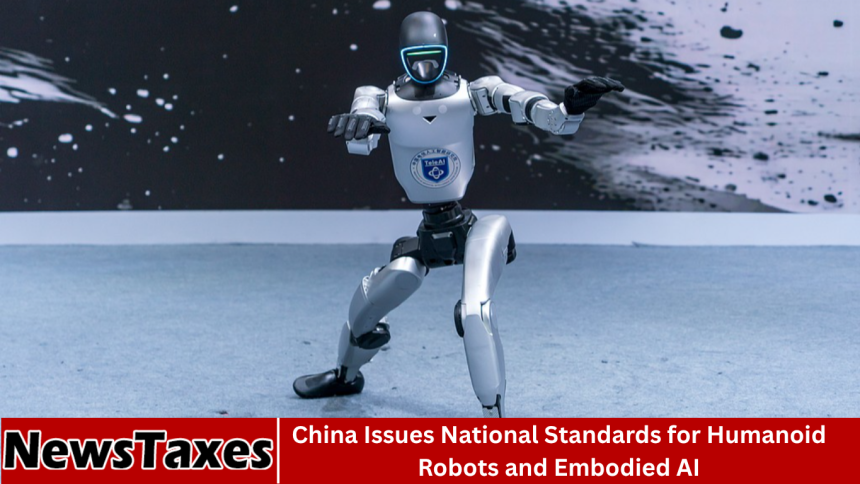
China has taken a major step toward shaping the future of artificial intelligence and robotics by introducing national standards for humanoid robots and embodied AI. This move reflects the country’s growing ambition to lead the next wave of technological innovation.
Artificial intelligence has traditionally existed in digital form—powering search engines, virtual assistants, and data analytics systems. However, the concept of embodied AI is changing this landscape. Embodied AI refers to intelligent systems that exist within a physical body.
Humanoid robots, which resemble human form and movement, are one of the most advanced examples of embodied AI. By issuing national standards, China is laying the groundwork for integrating these machines into everyday life in a structured and safe way.
More Read: Nvidia Beats Quarterly Expectations Amid Rising Concerns Over the AI Economy
Understanding Humanoid Robots and Embodied AI
What Are Humanoid Robots?
Humanoid robots are machines designed to look and function like humans. They typically feature:
- A head equipped with cameras and sensors
- Arms and hands capable of grasping objects
- Legs for walking or balancing
- Systems that allow interaction with humans
Their human-like design enables them to operate in environments built for people, such as homes, offices, and public spaces.
What Is Embodied AI?
Embodied AI is the intelligence behind the robot. It enables machines to:
- Process sensory information (vision, sound, touch)
- Make decisions based on real-time data
- Learn from interactions and experiences
- Perform physical tasks autonomously
In simple terms, embodied AI combines “brain” and “body,” making robots capable of functioning independently in the real world.
Overview of China’s National Standards
China’s national standard system for humanoid robots and embodied AI is a comprehensive framework designed to guide the industry’s growth. It covers the entire lifecycle of robotic systems, including:
- Research and development
- Manufacturing and integration
- Deployment and application
- Maintenance and upgrades
- Safety and ethical compliance
The goal is to create a unified structure that ensures all stakeholders—from developers to end-users—follow consistent rules and expectations.
The Six Core Areas of the Standard System
The framework is organized into six key categories, each addressing a crucial aspect of humanoid robotics:
Basic Standards and Definitions
This category establishes common terminology, measurement methods, and general technical requirements. It ensures that all developers and manufacturers operate using the same language and benchmarks.
Intelligent Computing Systems
This focuses on the AI “brain” of robots, including:
- Machine learning models
- Neural networks
- Decision-making algorithms
These standards ensure that robots can process information reliably and efficiently.
Hardware Components
This includes standards for physical parts such as:
- Sensors (vision, motion, touch)
- Actuators (movement mechanisms)
- Motors and joints
Consistency in hardware design improves compatibility and performance.
Complete Robot Systems
This area addresses the integration of hardware and software into a fully functional robot. It includes:
- System architecture
- Control systems
- Human-robot interaction
Application and Use Cases
These standards define how robots should operate in different environments, such as:
- Industrial settings
- Healthcare facilities
- Public services
- Homes
They also include guidelines for maintenance and operational safety.
Safety and Ethical Guidelines
This is one of the most critical components, covering:
- Risk management
- Data privacy
- Ethical decision-making
- Human safety protocols
These rules are essential for building trust in robotic systems.
Why Standardization Is Important
Promoting Industry Growth
A clear set of standards helps companies develop products more efficiently. It reduces uncertainty and encourages investment in robotics and AI technologies.
Ensuring Compatibility
Without standardization, different systems may not work together. Standards enable interoperability, allowing components and systems from different manufacturers to integrate seamlessly.
Enhancing Safety
Robots operating in real-world environments must meet strict safety requirements. Standards ensure that machines behave predictably and minimize risks to humans.
Building Public Trust
For humanoid robots to be widely accepted, people must trust them. A regulated framework reassures users that these systems are reliable and ethically designed.
China’s Strategic Vision
China’s push for humanoid robot standards is part of a broader strategy to lead in advanced technologies. Robotics and AI are seen as key drivers of economic growth and global competitiveness.
Government Support
The Chinese government has:
- Invested heavily in AI and robotics research
- Encouraged collaboration between academia and industry
- Developed policies to accelerate innovation
- Industrial Expansion
The robotics sector in China is rapidly growing, with increasing investment in:
- Startups
- Research institutions
- Manufacturing capabilities
- Long-Term Goals
China aims to:
- Become a global leader in AI and robotics
- Create a self-sufficient technology ecosystem
- Integrate intelligent machines into everyday life
- Real-World Applications of Humanoid Robots
- Manufacturing
Humanoid robots can handle repetitive and physically demanding tasks, improving efficiency and reducing labor costs in factories.
Healthcare
They can assist with:
- Patient monitoring
- Rehabilitation exercises
- Elderly care
- Service Industry
Robots are being used in:
- Hotels and restaurants
- Airports and customer service centers
- Retail environments
- Home Assistance
Advanced robots can help with daily tasks such as cleaning, organizing, and even companionship.
Global Impact of China’s Standards
China’s initiative could influence the global robotics landscape in several ways:
Setting Benchmarks
Other countries may adopt or adapt similar standards, making China a key player in defining international norms.
Competitive Advantage
Chinese companies could gain an edge by aligning early with these standards, enabling faster scaling and global expansion.
Technological Leadership
By leading in both innovation and regulation, China positions itself at the forefront of the AI revolution.
Challenges and Concerns
Ethical Questions
As robots become more autonomous, concerns arise about:
- Decision-making accountability
- Bias in AI systems
- Privacy and surveillance
- Job Displacement
Automation may replace certain types of jobs, particularly in manufacturing and service sectors.
Technical Barriers
Challenges include:
- High development costs
- Limited adaptability in complex environments
- Dependence on advanced hardware and computing power
- Safety Risks
Physical robots can pose risks if they malfunction, making strict safety standards essential.
The Role of Innovation Ecosystems
China’s success in robotics is supported by a strong ecosystem that includes:
- Universities conducting cutting-edge research
- Tech companies developing innovative solutions
- Government policies providing funding and direction
This collaborative environment accelerates progress and ensures rapid implementation of new technologies.
The Future of Humanoid Robots and Embodied AI
The future of humanoid robots is promising. With advancements in AI, sensors, and materials, these machines are expected to become:
- More intelligent and adaptive
- More affordable for businesses and households
- More integrated into daily life
China’s national standards provide a solid foundation for this future, ensuring that growth is both innovative and responsible.
Frequently Asked Question
What are humanoid robots?
Humanoid robots are machines designed to resemble humans in appearance and behavior, allowing them to operate in human environments.
What is embodied AI?
Embodied AI refers to artificial intelligence integrated into physical systems, enabling them to interact with the real world.
Why did China introduce these standards?
To regulate the industry, ensure safety, promote innovation, and accelerate the adoption of humanoid robots.
What industries will benefit the most?
Manufacturing, healthcare, service industries, and home automation are among the key beneficiaries.
Are these standards mandatory?
They are expected to guide industry practices and may become mandatory as regulations evolve.
What are the main risks of humanoid robots?
Key risks include safety concerns, ethical issues, and potential job displacement.
How will this affect the global robotics industry?
China’s standards could influence international regulations and give its companies a competitive advantage.
Conclusion
China’s introduction of national standards for humanoid robots and embodied AI marks a turning point in the evolution of artificial intelligence. By creating a comprehensive framework, the country is not only accelerating its own technological development but also setting the stage for global change. As robots become more capable and widespread, these standards will play a crucial role in ensuring safety, reliability, and ethical use.