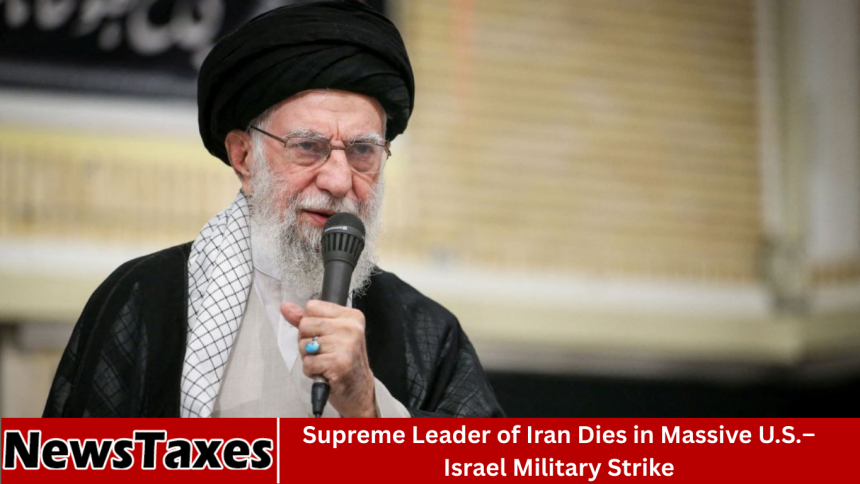
On February 28, 2026, the world witnessed a dramatic and unprecedented shift in international relations when Ali Khamenei, the Supreme Leader of Iran since 1989, was killed in a coordinated military operation carried out by the United States and Israel.
This operation, considered the largest offensive targeting Iranian leadership in decades, has sent shockwaves across the Middle East, impacting global politics, energy markets, and regional security. This article explores the background of Khamenei’s leadership.
The details of the military strike, Iran’s response, global reactions, and the potential long-term consequences of this historic event. Unlike his predecessor, Khamenei had experience as Iran’s president, giving him a comprehensive understanding of both domestic and international politics.
More Read: 25 Heartfelt and Dynamic Alternatives to ‘How Are You?’ That Spark Connection
Background: Ali Khamenei and Iranian Leadership
A Life in Power
Ali Khamenei, born in 1939, rose to prominence during Iran’s 1979 Islamic Revolution. Following the death of revolutionary founder Ruhollah Khomeini in 1989, Khamenei became Supreme Leader, assuming ultimate control over Iran’s political, military, and religious affairs.
During his 36-year tenure, Khamenei maintained strict control over the country’s military and clerical institutions. He oversaw Iran’s growing influence across the Middle East through alliances with proxy groups in Lebanon, Iraq, Yemen, and Syria.
His leadership emphasized resistance to Western influence, expansion of Iran’s missile program, and continued opposition to Israel. Domestically, he faced criticism for economic mismanagement, suppression of dissent, and human rights violations.
The Joint U.S.–Israel Military Operation
Planning and Execution
The military operation, reportedly codenamed “Operation Epic Fury,” involved extensive coordination between U.S. and Israeli forces. Early reports indicate that dozens of Iranian military bases, missile sites, radar installations, and leadership compounds were targeted.
The operation used precision missiles, airstrikes, and intelligence-backed tactics to hit strategic locations with maximum impact. The key objective was to neutralize Iran’s military leadership and prevent imminent threats posed by its nuclear ambitions and missile capabilities.
Intelligence agencies from both nations had been tracking Khamenei and his top aides for months, culminating in the strike on his Tehran compound.
The Strike
In the early hours of February 28, the offensive commenced with synchronized airstrikes on Tehran and surrounding areas. Initial reports suggest that over 500 targets were hit, including leadership compounds, military headquarters, and critical infrastructure.
Khamenei was killed during the strike, along with several close aides and family members present at the compound. Iranian authorities later confirmed the death of their Supreme Leader and declared a period of national mourning.
The government described Khamenei’s death as “martyrdom,” and images of his funeral processions were broadcast nationwide.
Immediate Aftermath
Iranian Retaliation
Iran responded swiftly to the attacks. Missile and drone strikes targeted U.S. and Israeli positions in the region, including military bases in Gulf countries. While many missiles were intercepted, at least one resulted in casualties.
Retaliatory attacks also occurred in neighboring regions, escalating tensions across the Middle East. The death of Khamenei has left a power vacuum in Iran. The Assembly of Experts, responsible for selecting the next Supreme Leader, faced disruption due to targeted strikes on its facilities.
Internal factions within the Iranian government and military are reportedly maneuvering to fill the leadership void, creating a complex political situation.
Human Cost
The military strikes caused significant civilian casualties. Reports indicate that more than 1,000 civilians may have died, including women and children. Cities like Tehran and southern Iran experienced destruction of residential areas and public facilities, intensifying humanitarian concerns.
The scale of destruction has prompted calls for international aid and relief efforts to assist affected populations.
Political Implications
Leadership Transition
The death of a Supreme Leader creates an unprecedented political crisis in Iran. Multiple factions, including conservative hardliners, reformists, and the Islamic Revolutionary Guard Corps (IRGC), are reportedly vying for influence in selecting Khamenei’s successor.
The transition period could redefine Iran’s political orientation, both domestically and in terms of its foreign policy.
Domestic Stability
The loss of Khamenei has triggered widespread uncertainty. Citizens, previously constrained by strict government control, have taken to the streets in some areas to protest or express dissent.
There are concerns that economic instability, coupled with political upheaval, could escalate social unrest in the coming months.
Global Reactions
Support and Condemnation
Reactions to the operation are deeply divided. In the U.S. and Israel, many political leaders praised the strike as a decisive blow against Iran’s leadership and a step toward regional security.
Some analysts argue that it could weaken Iran’s influence in proxy wars and curb its nuclear ambitions. Conversely, nations like China and Russia condemned the strike as aggressive and dangerous, warning that it could destabilize the region further.
International organizations emphasized the need for restraint, urging all parties to pursue diplomatic solutions and prevent further escalation.
Economic and Strategic Impact
The strike affected global oil markets due to fears of disruptions in the Strait of Hormuz, a key chokepoint for energy shipments. Oil prices spiked immediately following the attack, creating uncertainty in global energy supply and economic stability.
Regional alliances are also being reshaped. Sunni-majority countries, traditionally opposed to Iran, expressed cautious reactions. Iran’s network of proxy forces may intensify operations against U.S. and allied forces, potentially triggering new conflicts in Lebanon, Iraq, Syria, and Yemen.
Long-Term Outlook
Diplomatic Prospects
Although military action dominates the current narrative, diplomatic efforts are emerging. International actors are advocating for ceasefire agreements and negotiations to prevent a broader Middle East war.
The political vacuum in Iran presents both risks and opportunities for diplomatic engagement.
Future of Iran
Internally, Iran faces uncertainty. Economic challenges, political rivalries, and the potential rise of new leadership could reshape the nation’s trajectory. Regional dynamics, combined with global scrutiny, will influence Iran’s foreign policy and strategic decisions in the years ahead.
Frequently Asked Question
Was Ali Khamenei’s death officially confirmed?
Yes, Iranian state authorities confirmed Khamenei’s death, describing it as “martyrdom” and announcing a national period of mourning.
Why did the U.S. and Israel target Iran’s Supreme Leader?
The operation aimed to neutralize Iran’s leadership due to perceived threats, including nuclear ambitions, ballistic missile development, and regional military activities.
How did Iran respond militarily?
Iran launched missile and drone attacks on U.S. and Israeli bases in the Gulf region. Some missiles were intercepted, but several caused casualties, escalating tensions further.
Who will lead Iran now?
The Assembly of Experts is responsible for selecting the next Supreme Leader. Political factions, including the IRGC, are actively maneuvering to influence succession, creating uncertainty in leadership.
What is the impact on civilians?
Thousands of civilians have reportedly been affected by the strike, with casualties, infrastructure damage, and displacement causing severe humanitarian challenges.
How did the international community react?
Reactions are mixed: the U.S. and Israel praised the operation, while Russia, China, and others condemned it as destabilizing. International calls for diplomacy and restraint have increased.
Could this lead to a broader war?
Experts warn that the conflict could escalate regionally due to proxy forces and retaliatory attacks, making diplomatic intervention crucial to prevent further conflict.
Conclusion
The killing of Ali Khamenei in a joint U.S.–Israel military strike represents a historic turning point in Middle Eastern geopolitics. It has immediate implications for Iran’s leadership, regional stability, global energy markets, and international diplomacy. The coming weeks and months will determine whether the region moves toward escalation or seeks a diplomatic resolution.